
Why Agentic AI Matters
Artificial intelligence is evolving quickly. Some tools respond to prompts. Others can take action, make decisions, and work toward a goal. That second category is called agentic AI.
Agentic AI is changing how businesses use artificial intelligence in real workflows. Instead of only answering questions, it can plan tasks, use tools, analyze results, and improve its output step by step.
Companies like Innovative Labs 360 are exploring how AI-driven systems can improve automation, productivity, and digital operations.
What Is Agentic AI?
Agentic AI goes beyond simple responses. It can:
- Plan tasks
- Take action
- Observe results
- Adjust its approach while working toward a goal
For example, an agentic system can:
- Summarize support tickets
- Analyze contracts
- Review logs for issues
- Prepare research briefs
Agentic AI acts.
Reactive AI vs. Agentic AI
Reactive AI works best for one-step tasks such as:
- Drafting emails
- Translating text
- Summarizing documents
- Generating ideas
Agentic AI is built for multi-step work. It can:
- Break goals into tasks
- Choose tools
- Evaluate results
- Continue working until the task is complete
How Agentic AI Works
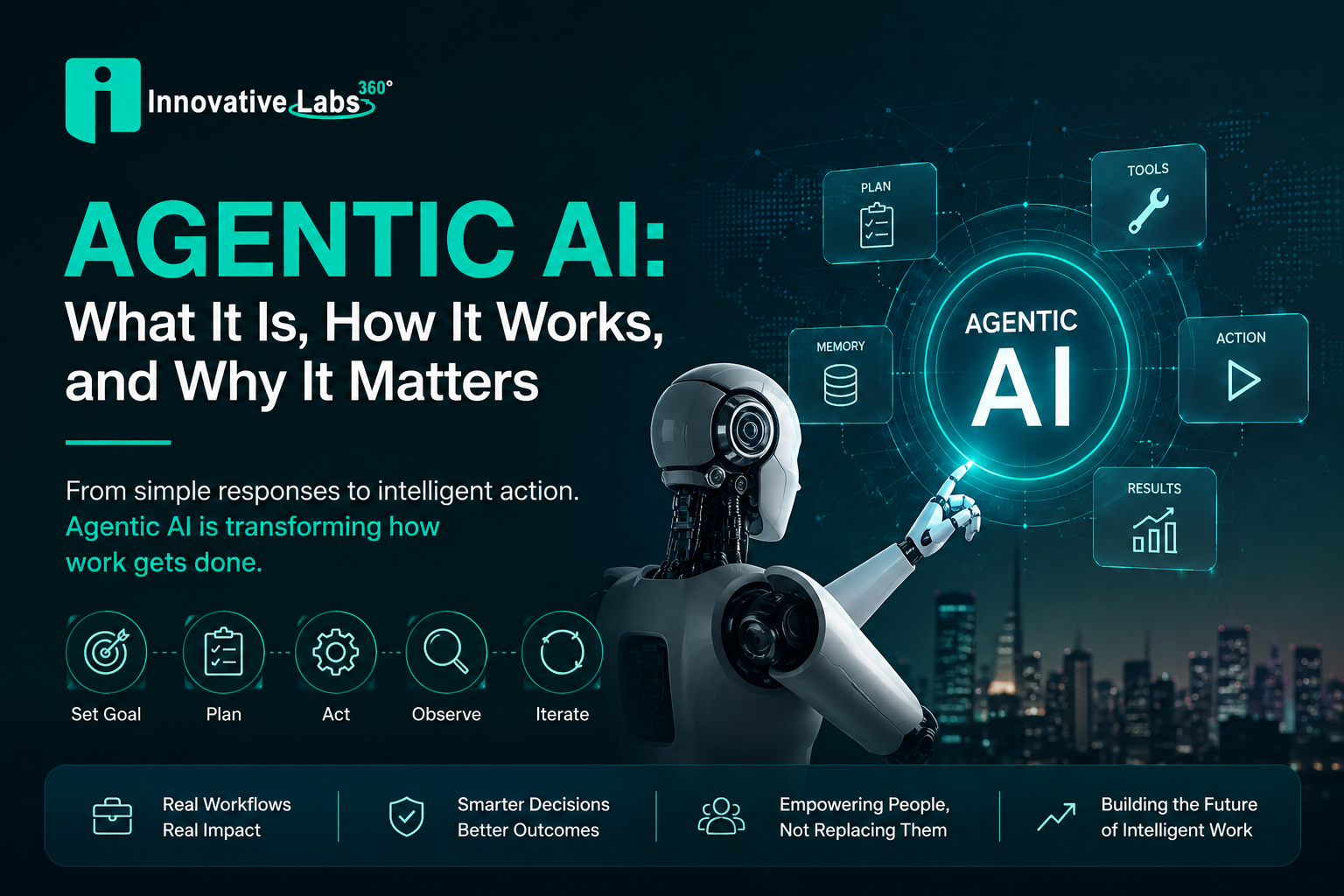
Most agentic systems follow a simple loop:
- Goal: The user provides an objective.
- Plan: The system decides how to approach the task.
- Act: It uses tools such as databases, search systems, CRMs, or code interpreters.
- Observe: The system checks whether the output is useful or accurate.
- Iterate: If needed, it adjusts and tries again.
Memory in Agentic AI
There are two important forms of AI memory.
Context Window
This is the information currently visible during a session, such as prompts and recent conversation history.
Vector Store
This supports longer-term retrieval of information such as:
- Project history
- Customer records
- Knowledge bases
- Internal documentation
Why Tool Use Matters
The real strength of agentic AI is its ability to use tools. Without tools, AI can only discuss work. With tools, it can help complete work.
- Databases
- Spreadsheets
- Ticketing systems
- CRMs
- Search engines
- Internal software platforms
Where Agentic AI Is Useful
In Legal Work
- Contract review
- Clause comparison
- Due diligence
- Document organization
In Software Development
- Debugging support
- Test generation
- Log analysis
- Issue triage
In Healthcare Operations
- Appointment coordination
- Intake workflows
- Administrative support
What Works Well Today
- Summarization
- Document retrieval
- Repetitive workflows
- Request classification
- Drafting first versions
What Is Still Improving
- Handling long, complex tasks
- Avoiding incorrect assumptions
- Adapting to unexpected situations
- Verifying accuracy consistently
Why Agentic AI Matters
The biggest impact is operational efficiency. Agentic AI helps businesses move faster by reducing repetitive work and improving workflow execution.
- Faster support response
- Improved research workflows
- Better internal operations
- Increased productivity