
Why Early-Stage Startups Need Compliance to Grow
Compliance for early-stage startups is the proactive establishment of legal, regulatory, and operational controls that protect your business and build the trust required for sustainable growth. Regulatory adherence, the recognized industry term for this discipline, covers everything from data privacy standards like GDPR to security certifications like SOC 2. Founders who treat startup compliance requirements as a day-one priority gain a measurable edge: faster sales cycles, stronger investor confidence, and far fewer expensive surprises at Series A. The cost of ignoring compliance early is not just legal. It shows up in lost deals, lower valuations, and organizational chaos that no amount of funding can quickly fix.

Why early-stage startups need compliance from day one
Compliance is not a checkbox you complete before an audit. Regulatory work begins the moment you make a business commitment, whether that is signing a customer contract, hiring your first employee, or processing a payment. Most founders assume they have months before compliance becomes relevant. That assumption creates what practitioners call "compliance debt," a backlog of unaddressed controls that compounds over time and becomes exponentially harder to unwind.
The importance of compliance for startups becomes concrete when you look at what it actually prevents. Compliance failures typically arise from ordinary gaps in procedural discipline, not dramatic legal violations. Those gaps erode customer trust and create cash flow problems before any regulator ever sends a letter. A startup that loses a key enterprise customer because it cannot produce a security audit report has suffered a compliance failure, even if no law was technically broken.
Three named standards define the compliance baseline for most early-stage tech startups: SOC 2 (System and Organization Controls 2) for security and availability, GDPR (General Data Protection Regulation) for data privacy in European markets, and HIPAA (Health Insurance Portability and Accountability Act) for any product touching health data. Knowing which of these applies to your business is the first step. Knowing when to start building toward them is the second.
What are the key compliance requirements early-stage startups face?
The specific startup compliance requirements you face depend on your sector, your customers' geography, and your product's data footprint. That said, several frameworks apply broadly across industries.
SOC 2 is the most common starting point for B2B SaaS startups. Achieving SOC 2 Type II certification can accelerate security review timelines by 6–16x, compressing what used to take weeks into days. Compliance costs for SOC 2 range from $15,000 to $50,000, with a 3–6 month implementation timeline. That investment pays back quickly when enterprise sales cycles shorten and procurement teams stop stalling deals over security questionnaires.
GDPR applies the moment you collect personal data from EU residents, regardless of where your company is incorporated. Fintech startups face additional layers: FinCEN registration, state money transmission licenses, and PCI DSS for card data. Healthcare and digital health startups must meet HIPAA's technical safeguards from the first line of product code. AI companies face emerging export control regulations and sector-specific transparency requirements that are still evolving in 2026.
The table below shows typical compliance frameworks, their primary trigger, and realistic planning timelines for early-stage startups.
Pro Tip: Map your regulatory exposure before you write your first product specification. Regulatory exposure affects product architecture, hiring decisions, and investor terms. Discovering it late can force costly investment unwinds that no early-stage company can easily absorb.
How does early compliance impact fundraising and investor relations?
Investors treat compliance posture as a direct signal of leadership quality. A founder who has mapped regulatory exposure, documented controls, and maintained clean audit trails signals that the business is built to last. A founder who has not done this work signals the opposite, regardless of how strong the product or revenue numbers look.
Investors apply valuation discounts for startups with uncontrolled compliance failures, and they frequently abandon deals or lower offer prices when diligence surfaces gaps. This is not a theoretical risk. It is a pattern that plays out in Series A and Series B rounds across every sector. The cost of a professional regulatory exposure mapping engagement runs between $5,000 and $20,000. That is far cheaper than the valuation haircut or deal collapse that comes from discovering problems during investor diligence.
Compliance is a governance design decision that enables probabilistic risk management. It is not merely a legal burden. Founders who internalize this shift stop asking "when do we have to do this?" and start asking "how do we build this into how we operate?" That mindset change is what separates startups that scale cleanly from those that stall at growth inflection points.
Source: Building compliance into startup DNA
The benefits of compliance for startups extend beyond avoiding penalties. A well-documented compliance program shortens investor due diligence timelines, reduces legal fees, and gives your leadership team a clear framework for decision-making under uncertainty. Investors who evaluate your privacy and data standards posture during funding rounds are looking for evidence that you understand your risk surface. A Trust Center or published security documentation is often the difference between a fast close and a prolonged negotiation.
Key investor concerns that compliance directly addresses:
Unresolved regulatory exposure in target markets
Absence of documented security controls or audit history
Personal founder liability from egregious regulatory breaches
Gaps in data handling that create post-acquisition liability
No clear ownership of compliance responsibilities within the leadership team
What operational challenges do startups face when implementing compliance?
The most common misconception founders hold is that compliance begins at the audit stage. Startups routinely misjudge compliance timelines, assuming the work starts when an auditor arrives or when a customer asks for a report. By that point, the real work, which includes controls design, evidence collection, and cross-functional coordination, should already be months underway.
The hidden workload of compliance catches most early teams off guard. Controls design requires input from engineering, legal, HR, and operations simultaneously. Evidence collection means maintaining logs, policies, and records continuously, not assembling them retroactively before an audit. Cross-functional collaboration is not optional. A compliance program that lives only in the legal team's folder is a compliance program that will fail.
Startup culture largely determines compliance success. When compliance responsibility is siloed in one person or one department, bottlenecks form and failures follow. The most effective programs distribute ownership across teams, with engineering owning technical controls, HR owning personnel policies, and leadership owning the overall governance framework. The organizational culture a founder builds in the first 18 months directly shapes whether compliance becomes embedded practice or a recurring fire drill.
In North American jurisdictions, founders risk personal liability when regulatory compliance is breached egregiously. That fact alone should reframe how founders think about compliance ownership. It is not a task to delegate and forget. It is a leadership responsibility with personal consequences.
Pro Tip: Treat compliance like technical debt. Every week you delay building a control is a week of evidence you cannot recover. Start your SOC 2 readiness assessment in the same sprint you define your product architecture.
Common operational pitfalls to avoid:
Assuming compliance is a one-time project rather than an ongoing operational layer
Centralizing all compliance work in a single role without cross-team accountability
Skipping policy documentation because the team is small and "everyone knows the rules"
Delaying hiring decisions that carry regulatory implications (e.g., data protection officers)
Treating security questionnaires from prospects as the trigger for compliance work
How can startups build a compliance program without stalling growth?
A compliance program does not need to be complex to be effective. The right starting point for most early-stage startups is proportionate compliance: match the framework to your actual risk surface and customer requirements, not to what a Fortune 500 company would implement.
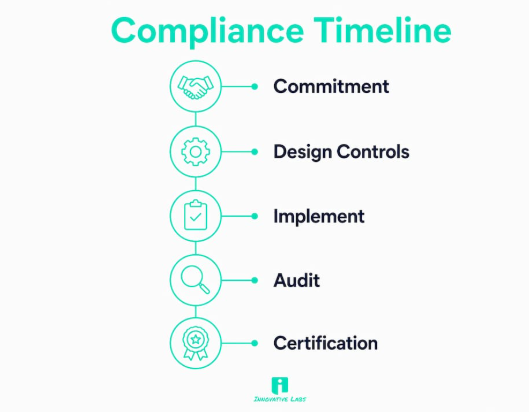
The four phases of a practical compliance program for startups are:
Regulatory mapping. Identify every jurisdiction, sector, and data type your product touches. This phase produces a regulatory exposure map that guides every subsequent decision.
Controls design. Define the specific policies, procedures, and technical controls required by your target frameworks. Assign ownership to specific roles, not just departments.
Implementation. Build controls into your product, hiring process, and vendor management from the start. Early compliance integration into product architecture prevents the expensive retrofitting that kills momentum at scale.
Proof of operation. Collect continuous evidence that controls are working. This is what auditors and investors actually evaluate.
The table below compares three common compliance approaches and their practical trade-offs for early-stage startups.
Pro Tip: Assign a named compliance owner before your first enterprise sales conversation. Purchasing teams expect mature, verifiable controls and a Trust Center. Without them, sales cycles extend significantly and deals stall at procurement.
Integrating compliance into hiring decisions is one of the highest-leverage moves an early-stage founder can make. When you hire your first data engineer, include data handling policies in onboarding. When you bring on a sales lead, brief them on what your compliance posture covers and what it does not. Compliance awareness embedded in hiring and onboarding creates the distributed ownership that makes programs sustainable. You can also assess early compliance risk before committing to a specific product architecture, which saves significant rework later.
Compliance is a growth strategy, not a legal formality
Most founders I have worked with treat compliance as something that happens to their startup rather than something they build into it. That framing is the root cause of most compliance failures I have seen. The founders who get this right are not the ones with the biggest legal budgets. They are the ones who decide early that governance is a leadership function, not a legal department function.
The mistake I see most often is waiting until a customer asks for a SOC 2 report or an investor requests a regulatory map before starting the work. By that point, you are already behind. You are negotiating from weakness, and the cost of catching up, in time, money, and organizational distraction, is far higher than the cost of starting early.
Overcentralizing compliance in one person is the second most common failure mode. When the "compliance person" leaves or gets overwhelmed, the entire program collapses. The startups that build durable compliance programs treat it the way they treat engineering quality: everyone owns a piece of it, and the standards are written down.
How Innovative Labs builds compliance into your software from day one
Startups that wait to address compliance after their product is built pay for it twice: once to build the product, and again to retrofit the controls that should have been there from the start.
Innovative Labs integrates compliance requirements directly into custom software development, so your product is audit-ready before your first enterprise sales conversation. With a decade of experience building HIPAA-compliant and SOC 2-aligned platforms, the team at Innovative Labs plans security controls, access management, and data handling into the product architecture from the first sprint. Founders who work with Innovative Labs arrive at investor diligence with documented controls and a clear regulatory map, not a remediation backlog. That preparation shortens security reviews, strengthens valuations, and keeps growth on track.
Key takeaways
Compliance built into a startup's operations from day one reduces investor risk, shortens sales cycles, and prevents the costly remediation that derails growth at Series A and beyond.
FAQ
What does compliance mean for an early-stage startup?
Compliance means building the legal, regulatory, and operational controls your business needs to operate safely and earn customer and investor trust. For most early-stage startups, this includes data privacy standards, security certifications, and sector-specific regulations relevant to their product and markets.
When should a startup start working on compliance?
Compliance work begins at the moment a business commitment is made, not at the audit stage. Founders who delay until a customer or investor requests documentation are already behind and face higher remediation costs.
How does SOC 2 certification help a startup grow?
SOC 2 Type II certification signals to enterprise buyers and investors that your security controls are verified and operational. It can reduce security review timelines by 6–16x, which directly shortens sales cycles and accelerates deal closes.
Can compliance gaps affect a startup's funding round?
Compliance gaps discovered during investor diligence frequently result in valuation discounts or deal abandonment. Investors treat uncontrolled regulatory failures as direct evidence of leadership and governance risk, not just legal exposure.
How much does early compliance cost compared to fixing it later?
Professional regulatory exposure mapping costs between $5,000 and $20,000. That is a fraction of the cost of remediating compliance failures during Series A diligence, where deal delays and valuation haircuts can cost multiples of that amount.