

Cloud Infrastructure for Startups Explained: 2026 Guide
Cloud infrastructure for startups is defined as the collection of cloud-based compute, storage, networking, and managed services that replaces traditional on-premise hardware and lets early-stage companies scale without buying physical servers. Getting this right from day one separates startups that grow cleanly from those that rebuild everything at Series A. Cloud infrastructure for startups explained is not just a technical topic. It is a business decision that directly shapes your cost structure, speed to market, and ability to attract enterprise customers who demand compliance certifications like SOC 2 and ISO 27001. In 2026, cloud ROI for startups is measured across five dimensions: time-to-market acceleration, infrastructure elasticity, security compliance, integration depth, and cost predictability. That framework tells you exactly what to evaluate before signing up for any platform.

What are the core components of cloud infrastructure for startups?
Cloud infrastructure breaks down into five building blocks. Every startup needs to understand each one before choosing a platform or signing a contract.
Compute resources are the processing power your application runs on. You have three main options:
Virtual machines (VMs) give you a full operating system environment. They suit workloads that need persistent processes or legacy software.
Containers package your application and its dependencies together. Docker and Kubernetes are the dominant standards here, and containers let you move workloads between environments without rewriting code.
Serverless platforms like AWS Lambda let you run code without managing servers, which cuts operational overhead and improves scaling for event-driven workloads. You pay only for the milliseconds your code runs.
Storage comes in three forms. Object storage (think S3-compatible buckets) holds unstructured data like images, logs, and backups at low cost. Block storage acts like a hard drive attached to a VM, ideal for databases. File storage provides shared access across multiple instances, useful for content management systems.
Networking ties everything together. Managed load balancers distribute traffic across your compute instances so no single server becomes a bottleneck. Content delivery networks (CDNs) cache your static assets at edge locations worldwide, cutting latency for global users. Private networking isolates your internal services from the public internet, which is a baseline security requirement for any startup handling user data.
Managed database services remove the burden of patching, backups, and replication from your engineering team. PostgreSQL-compatible managed databases, for example, let a two-person team run a production-grade data layer without a dedicated database administrator.
Security services built into cloud platforms include firewalls, identity and access management (IAM), and encryption at rest and in transit. Microsoft Azure, for instance, reduces identity synchronization setup from 3 days to 45 minutes for companies already using Microsoft 365. That kind of integration matters when your team is small and every hour counts.
For data-intensive startups building AI products, Google Cloud's Vertex AI pipelines reduce model training iteration times by 63% compared to generic Kubernetes alternatives. That is not a marginal gain. It means shipping a model update in days instead of weeks.
How do cloud infrastructure options impact startup cost and ROI?
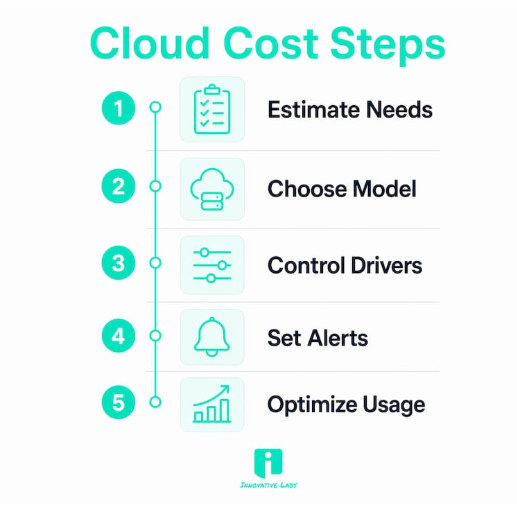
Cost is where most early-stage founders make their biggest mistakes. The three common billing models are pay-as-you-go, reserved instances, and startup credits.
Pay-as-you-go charges you for what you use, billed hourly or by the second. Reserved instances require a one-year or three-year commitment in exchange for discounts of 30%–60% off on-demand rates. Startup credits programs from Google, Microsoft, AWS, Oracle, IBM, and DigitalOcean offer from $5,000 up to $250,000 or more to reduce upfront infrastructure costs. Credits are free money. Apply for every program your startup qualifies for before spending a dollar.
The key drivers of cloud cost are compute, storage, network egress, managed services, and observability tooling. Network egress is the one that surprises founders most. Moving data out of a cloud provider's network costs money, and those charges compound fast at scale.
The most accurate way to estimate your bill is to work backward from your application requirements, not forward from vendor pricing pages. Start with your expected compute needs, add storage and database costs, then layer in egress and monitoring. Chasing SKU prices without knowing your workload profile leads to poor decisions.
Pro Tip: Set a billing alert at 80% of your monthly budget threshold. Most platforms send these alerts for free, and catching a runaway process early can save thousands of dollars.
Startups that use compute autoscaling and right-size their managed database instances consistently spend less per unit of output than those running fixed infrastructure. The savings are not theoretical. They show up in your monthly invoice.
What are best practices for scaling cloud infrastructure as your startup grows?
Scaling without disruption requires deliberate architecture choices from the start. These are the practices that matter most:
Design for modularity. Break your application into independent services that can scale separately. A monolith that works at 1,000 users often collapses at 100,000. Microservices and serverless functions let you scale only the components under load, not the entire application.
Implement CI/CD pipelines. Continuous integration and continuous deployment pipelines automate testing and release. Teams using CI/CD ship code faster and with fewer production incidents. Tools like GitHub Actions and GitLab CI are widely adopted and integrate with every major cloud platform.
Build observability in from day one. Monitoring, logging, and distributed tracing are not optional extras. You cannot fix what you cannot see. Set up dashboards for latency, error rates, and resource utilization before you launch, not after your first outage.
Automate your security posture. Manual security reviews do not scale. Use infrastructure-as-code tools like Terraform to enforce security policies consistently across every environment. This approach also makes SOC 2 and ISO 27001 audits significantly less painful.
Deploy across multiple regions. Single-region architectures create single points of failure. Multi-region deployment adds redundancy and reduces latency for users in different geographies. Review IT infrastructure redundancy best practices before designing your production architecture.
Balance managed services against DIY. Managed services cost more per unit than self-managed alternatives, but they save engineering time. For a five-person team, paying a premium for a managed Kubernetes service is almost always the right call. For a 50-person team with a dedicated platform engineer, self-managed may make sense.
Pro Tip: Run a cloud health assessment covering spend, security posture, compliance alignment, and latency benchmarking at least once per quarter. A focused three-hour session can surface issues that would otherwise cost you months of engineering time.
Startups that build modular architectures from the beginning consistently accelerate their MVP deployment cycles. The upfront design investment pays back within the first major scaling event.
How to choose the right cloud platform and services for your startup?
Platform selection is not a permanent decision, but switching later is expensive. Get it right early by evaluating these factors:
Your existing toolset. If your team already uses Microsoft 365, Azure's identity integration cuts setup time dramatically. If your engineers know Python and want to build ML features, Google Cloud's AI tooling gives you a head start.
Pricing transparency. Some platforms publish clear, predictable pricing. Others require a sales call to get a real number. Predictable pricing matters more than low headline rates when you are managing a tight budget.
Ecosystem integration. The platform you choose should connect cleanly with your payment processor, CRM, and data warehouse. Integration gaps create engineering debt that compounds over time.
Startup credit programs. Apply for credits before committing to a platform. The credit amount can effectively make one platform free for your first year, which changes the economics entirely.
Operational simplicity. Bootstrapped startups often do best with platforms that offer predictable pricing and lower operational friction. Teams that want minimal DevOps overhead benefit from managed hosting platforms that abstract away server management entirely.
Choosing a managed network services provider that fits your team size is equally important. Small IT teams need providers that handle monitoring and incident response, not just connectivity.
Avoid chasing every new service a platform announces. Focus on the services your current workload actually needs. Adding complexity before you need it creates maintenance burden without adding user value.
Key Takeaways
Startup cloud infrastructure works best when founders understand their workload requirements first, then select platforms and billing models that match those needs precisely.
What I've learned from watching startups get cloud infrastructure wrong
Most founders I work with make the same mistake: they treat cloud infrastructure as a technical problem instead of a business decision. They spend weeks comparing instance pricing across platforms while ignoring the question of what their application actually needs to run well.
The startups that scale cleanly share one habit. They build cost awareness into their culture from the first sprint. Every engineer knows what the team spends per month and why. That transparency prevents the slow drift of unused resources and forgotten test environments that quietly doubles your bill over six months.
The other pattern I see consistently is over-engineering at the wrong stage. A founder with three paying customers does not need a multi-region Kubernetes cluster with a service mesh. They need something that works reliably and lets them ship features. The time you spend on infrastructure complexity before product-market fit is time you are not spending on customers.
Cloud providers are genuinely improving their startup tooling. The gap between what a two-person team can operate today versus five years ago is significant. But that capability comes with a responsibility to stay current. The founders who invest in learning cloud operations continuously make better decisions than those who set up infrastructure once and forget it.
How Innovative Labs supports startup cloud infrastructure
Building cloud infrastructure correctly from the start requires more than reading guides. It requires hands-on experience with the edge cases that only appear in production.
Innovative Labs has spent a decade building and managing scalable cloud platforms for startups and enterprises, including systems that meet HIPAA and SOC 2 compliance standards. The team integrates custom software development, cloud architecture, and round-the-clock IT support into a single engagement model. Founders get infrastructure that is built to scale and actively maintained. Explore Innovative Labs' cloud case studies to see how the team has helped startups cut infrastructure costs and accelerate deployment timelines.
FAQ
What is cloud infrastructure for startups?
Cloud infrastructure for startups is the set of cloud-based compute, storage, networking, and managed services that replaces physical servers and supports rapid scaling. It gives early-stage companies the flexibility to grow without large upfront hardware investments.
How much does cloud infrastructure cost for a startup?
Cloud costs vary by workload, but startup credit programs from major providers offer between $5,000 and $250,000 or more to offset early infrastructure expenses. After credits, most early-stage startups spend between a few hundred and a few thousand dollars per month depending on traffic and data volume.
What cloud platform is best for a bootstrapped startup?
Platforms with predictable pricing and low operational friction suit bootstrapped teams best. Bootstrapped startups benefit from providers offering flat-rate pricing and built-in DDoS protection rather than complex per-service billing.
How do I scale cloud infrastructure as my startup grows?
Design modular architectures using microservices or serverless functions, implement CI/CD pipelines, and use autoscaling to match compute capacity to actual demand. Review how to scale a cloud platform for a step-by-step approach tailored to early-stage companies.
How often should startups review their cloud setup?
Startups should run a cloud health assessment covering spend, security posture, compliance alignment, and latency benchmarking at least once per quarter. A focused review session regularly surfaces cost savings and security gaps before they become serious problems.
Recommended
How to Scale a Cloud Platform for Early-Stage Startups - Innovative Labs
The Role of Cloud Migration in Enterprises: 2026 Guide - Innovative Labs