

How to Scale a Cloud Platform for Early-Stage Startups
Insights from Innovative Labs 360
Scaling a cloud platform at the early stage means choosing infrastructure that grows with your product without requiring a full DevOps team to manage it. Cloud scalability allows startups to test, deploy, and reach global users without hardware procurement delays.
Startup credit programs from Google Cloud, CircleCI, DuploCloud, and Scaleway now provide thousands of dollars in cloud service coverage, making cloud adoption more accessible than ever. This guide explores the tools, architecture decisions, and practical steps needed to scale cloud infrastructure without burning valuable runway.
What Financial Resources Help Startups Scale Cloud Platforms Early?
Startup credit programs are one of the fastest ways to reduce infrastructure costs. These programs fund compute, storage, networking, CI/CD pipelines, and managed services before a startup generates meaningful revenue.
| Program | Credit Range | Primary Benefit |
|---|---|---|
| Google Cloud for Startups | Up to $200,000 | Compute, Storage, AI/ML Services |
| CircleCI Startup Credits | Up to $20,000 | CI/CD Pipeline Automation |
| DuploCloud | Varies by Stage | AI DevOps & Compliance Automation |
| Scaleway Startup Program | Up to $36,000 | Cloud Compute & Managed Services |
What Platform Features Actually Support Early-Stage Cloud Scaling?
The best cloud platforms eliminate operational complexity before it becomes a bottleneck. Three capabilities matter most for startups: scale-to-zero billing, autoscaling with spending controls, and managed platform-as-a-service (PaaS) solutions.

Key Features to Prioritize
- Scale-to-Zero: Automatically shuts down idle resources to eliminate unnecessary costs.
- Autoscaling: Expands and contracts resources based on demand.
- Spending Limits: Prevents unexpected cloud bills during traffic spikes.
- Managed PaaS: Reduces DevOps overhead and simplifies deployment.
- AI Optimization: Uses automation to identify and eliminate cloud waste.
Platforms like Laravel Cloud, Railway, and Render help startups focus on building products rather than maintaining infrastructure. AI-driven tools such as JetScale AI and ScaleOps further reduce operational overhead through automated optimization.
How to Scale a Cloud Platform Step by Step
Scaling cloud infrastructure requires a repeatable process rather than ad-hoc decisions. The following framework helps startups move from MVP to growth stage efficiently.
- Choose a managed or cloud-native platform.
- Implement CI/CD pipelines from day one.
- Adopt Infrastructure as Code (IaC).
- Configure autoscaling with spending limits.
- Integrate AI-powered optimization tools.
- Build compliance controls into the architecture.
- Review performance and costs monthly.
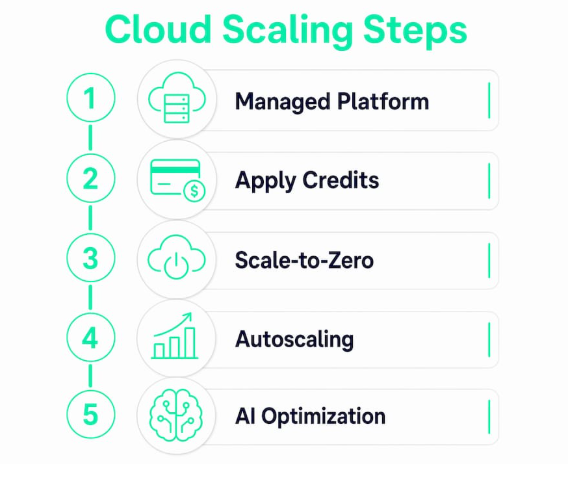
| Step | Tool or Method | Primary Outcome |
|---|---|---|
| Managed Platform | Laravel Cloud, Railway, Render | Reduced DevOps Overhead |
| CI/CD Pipeline | CircleCI, GitHub Actions | Automated Deployments |
| Infrastructure as Code | Terraform, AWS CloudFormation | Repeatable Scaling |
| Autoscaling Limits | Cloud Provider Settings | Cost Control |
| AI Optimization | ScaleOps, JetScale AI | Proactive Cost Reduction |
| Compliance Integration | DuploCloud | Audit-Ready Architecture |
What Are the Biggest Cloud Platform Challenges for Early-Stage Startups?
- Over-engineering infrastructure before product-market fit.
- Hidden costs such as egress fees and API charges.
- Unpredictable scaling expenses during growth.
- Compliance debt caused by delaying security planning.
- Operational complexity from unmanaged cloud environments.
Startups that scale effectively treat infrastructure decisions as business decisions. Every architectural choice impacts speed, operating costs, and enterprise readiness.
Key Takeaways
| Point | Details |
|---|---|
| Apply for Startup Credits | Reduce infrastructure costs using cloud credit programs. |
| Use Scale-to-Zero Platforms | Pay only for active resources. |
| Set Spending Limits | Prevent unexpected cloud expenses. |
| Integrate Compliance Early | Avoid costly rework later. |
| Adopt AI Optimization | Automate cost reduction and infrastructure management. |
Why Most Startups Scale Cloud Infrastructure Backwards
Many founders treat cloud infrastructure as a problem to solve once. They choose a provider, deploy servers, and move on. However, infrastructure must evolve alongside the product.
The startups that scale successfully often choose managed, predictable infrastructure over complex custom architectures. Managed platforms keep engineering teams focused on product development instead of operational maintenance.
How Innovative Labs 360 Helps Startups Scale
Innovative Labs 360 works with early-stage technology companies that need cloud infrastructure built for growth. Our team supports architecture design, CI/CD implementation, autoscaling, compliance readiness, and ongoing managed cloud services.
By combining cloud engineering expertise with compliance-focused architecture, we help startups scale faster while maintaining predictable costs and operational efficiency.
Frequently Asked Questions
What does it mean to scale a cloud platform early stage?
It means building infrastructure that automatically grows with demand while minimizing operational complexity and upfront investment.
How much do startup cloud credit programs offer?
Depending on the provider and startup stage, programs can offer between $5,000 and $200,000 in credits.
What is scale-to-zero?
Scale-to-zero technology automatically shuts down idle resources so startups only pay for infrastructure when it is actively being used.
How can startups avoid hidden cloud costs?
Use transparent pricing models, monitor spending closely, and implement budget alerts with autoscaling limits.
When should compliance controls be implemented?
Compliance controls such as SOC 2, HIPAA, and GDPR should be integrated from day one to avoid costly rework later.