
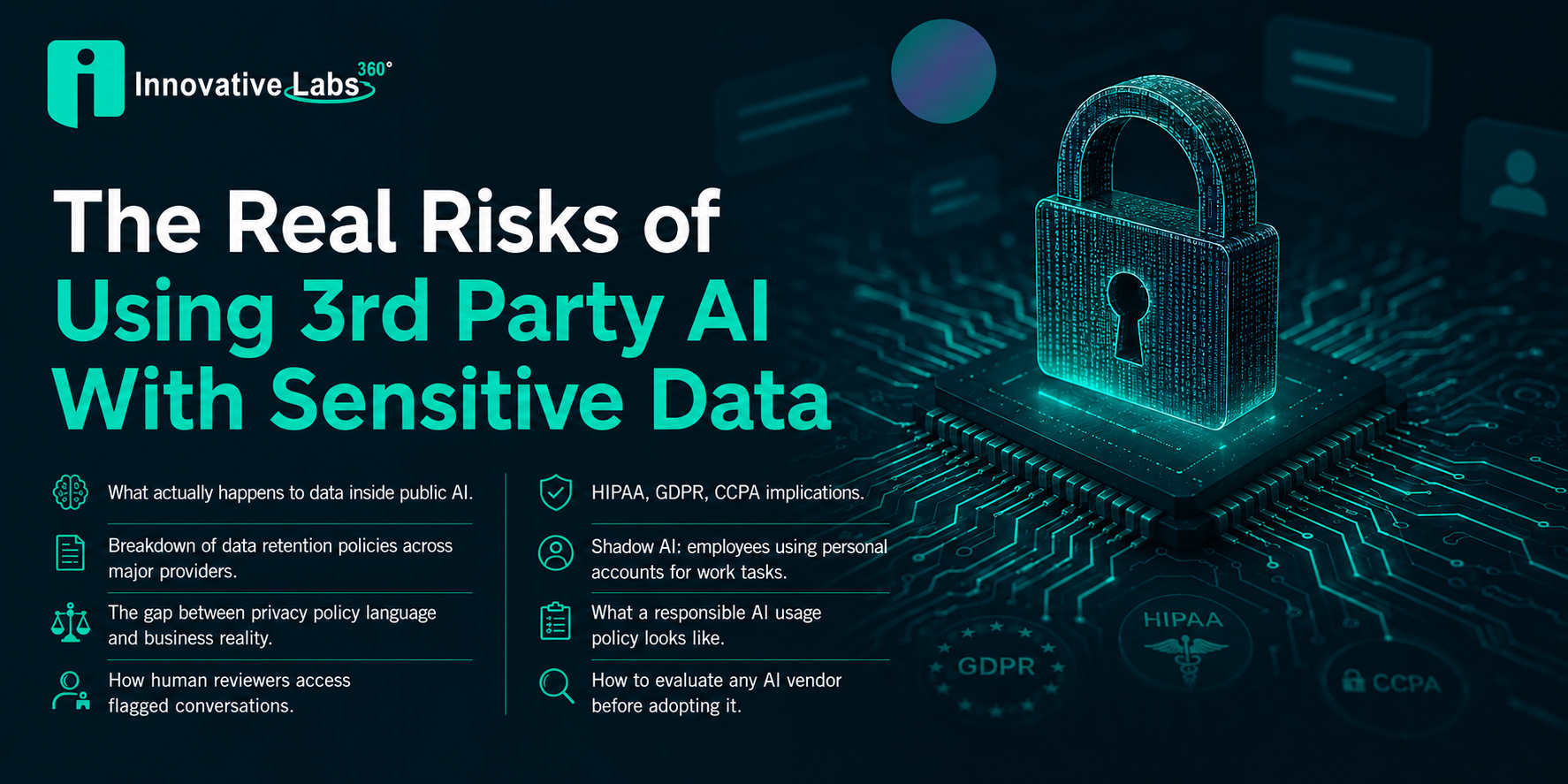
The Real Risk of Using Third Party AI With Sensitive Data
AI tools can save time, improve productivity, and help teams work smarter. But when employees use public or third party AI platforms with sensitive business data, the risk is often bigger than it appears.
The issue is not AI itself. The issue is what happens when confidential information leaves your company’s controlled environment and enters a platform your organization has not reviewed, approved, or secured.
For businesses, the safest path is not to avoid AI completely. It is to use AI responsibly, with clear rules, trusted vendors, and strong data protection practices.
What Happens to Data Inside Public AI Tools?
When someone enters information into a public AI tool, that data may be processed on the provider’s systems. Depending on the tool, account type, and settings, the information may also be stored, logged, reviewed for safety, or used to improve the service.
This matters because employees may paste in customer records, contracts, financial details, internal plans, or private company information without realizing the potential exposure.
A public AI account is not the same as an enterprise AI solution with security controls, admin oversight, and contractual protections. Businesses should never assume that all AI tools protect data in the same way.
The Hidden Gap Between Privacy Policies and Reality
Many AI providers publish privacy policies that sound reassuring. But a privacy policy does not always explain the full business reality.
Companies need to know how long data is kept, whether it can be used for model improvement, who can access it, where it is stored, and what happens when a user deletes a conversation.
The real risk appears when employees use tools before the business has answered those questions. A tool may be fine for public information, but unsafe for sensitive data such as customer files, legal documents, healthcare information, employee records, or proprietary code.
Human Review and Compliance Concerns
Some AI platforms may allow limited human review of certain conversations, especially when content is flagged for safety, abuse prevention, support, or quality control.
That does not mean every conversation is read by a person. But it does mean businesses should understand when human access is possible.
This is especially important for organizations subject to privacy and compliance requirements. HIPAA, GDPR, CCPA, and other regulations may apply when personal, health, financial, or protected data is entered into an AI system.
If the right agreements and safeguards are not in place, a simple AI prompt can create a serious compliance problem.
Shadow AI Is Already Happening
Shadow AI happens when employees use AI tools without company approval. It is one of the fastest growing risks in modern workplaces.
- An employee might use a personal AI account to summarize a contract.
- A manager might upload sales data for analysis.
- A developer might paste source code into a chatbot.
- A support team member might use AI to rewrite a customer response that includes personal information.
Most employees are not trying to create risk. They are trying to work faster. But without guidance, sensitive data can easily end up in the wrong place.
Businesses need to make safe AI use simple, clear, and accessible.
Building a Safer AI Culture
Technology controls are important, but culture matters just as much. Employees need to understand that responsible AI use is not about limiting innovation. It is about protecting the business, its customers, and its reputation.
A safer AI culture starts with simple training, clear examples, and approved tools that are easy to access. When teams know what they can use, what they should avoid, and when to ask for guidance, AI becomes a business advantage instead of a hidden risk.
What Responsible AI Use Looks Like
A responsible AI policy should clearly explain which tools are approved, what data can be used, what data is prohibited, and when employees need permission.
The policy should also require company approved accounts instead of personal accounts, human review of AI outputs, and a simple reporting process if sensitive data is accidentally shared.
Good AI governance should not slow the business down. It should help teams use AI confidently while protecting customers, employees, and company information.
How to Evaluate an AI Vendor
Before adopting any AI vendor, businesses should ask practical questions.
- Does the vendor use customer data to train models?
- How long is data retained?
- Can data retention be limited?
- Are prompts and files reviewed by humans?
- Where is data stored?
- What security controls are in place?
- Does the vendor provide enterprise access controls, audit logs, and legal agreements when needed?
The goal is not to reject every tool. The goal is to match the tool to the risk of the data being used.
Public information may require lighter review. Sensitive, regulated, or confidential data requires much stronger protection.
The best organizations will not be the ones that ignore AI risk or ban AI completely. They will be the ones that build clear policies, choose trustworthy vendors, train employees, and use AI with intention.
Innovative Labs 360 helps businesses adopt AI responsibly, reduce risk, and build practical governance frameworks that support innovation without compromising sensitive data.